Showing posts with label Birds In Backyards. Show all posts

Monday, 12 May 2025

Birds in Backyards Survey


The Birdlife Australia (BA) Autumn Birds In Backyards survey is now open. The purpose of this survey is to see how birds are doing in our urban areas. Cities can be hostile places for birds. Birdlife Australia wants to know about things like bird numbers, their behaviour and what features of gardens they like, and what they avoid.

Most people will be able to take part in these surveys easily, even if they have little birding experience. The survey forms will help you to identify common birds in your area to get you started. The data gathered will provide important information for BAs team of scientists.

You can participate in a Birds in Backyards seasonal survey almost anywhere. If you’ve got a backyard, you can do it there. However, even people who don’t have backyards can take part. Any location near your home where you can see birds is fine.


Wednesday, 20 September 2023

Aussie Bird Count

The Aussie Bird count is looming, 16-22 October, a great citizen science project that gets you out and about for 20 minutes, contemplating the beautiful bushland suburb we live and counting the birds we share it with. There’s time to download the app and start getting your ID eye fine-tuned.

The Aussie Bird count website has a handy bird finder tool and a webform, or there’s the app if you want to venture into one our beautiful reserves and do your count there.

Last year’s national survey showed that many of the top 10 NSW birds were also common locally.
  • Rainbow Lorikeet
  • Noisy Miner
  • Sulphur-crested Cockatoo
  • Australian Magpie
  • Galah
  • Welcome Swallow
  • Common Myna
  • Little Corella
  • Silver Gull
  • Crested Pigeon

Wednesday, 15 March 2023

It’s all about the birds in our bushland suburb

You can’t help being aware of the abundance of birds that call the Coal Point peninsula home. From the early morning kak of the kookaburras, the daytime chattering of lorikeets to the soothing hoots of the nocturnal owls, there’s hardly a time throughout the day when our bird-buddies are absent from our ears.

This ever-present connection to nature is good for our mental health and the bushland that they need to survive offers another layer of ambient wellbeing.


Neighbours Noticing Nature

“Just wanted you to know we’ve been visited lately by a juvenile Blue-faced Honeyeater but haven’t seen any adults as yet. The juvenile doesn’t have the blue area around the eyes.

Other locals may have seen this very striking bird, but we’ve never had the privilege of such a visit in the 39 years we’ve lived in Coal Point.

It’s such a treat to sit on our deck surrounded by beautiful big trees and greet our feathered friends every day”.


Want to know about the Birds in your Backyard?

The Autumn seasonal survey by BirdLife Australia is now on until the end of April. The citizen science survey tracks the health of our urban birds, and allows the urban bird team to monitor the impact of our gardens, outdoor spaces and even our own behaviours on bird populations. A lot can be learnt from Birds in Backyard surveys, such as how different types of gardens can attract different types of birds, and which features birds may be avoiding or are negatively affected by. The data were recently used in a study showing the decline of even some of our most common birds in major cities across Australia.

To participate in the survey spend 20 minutes somewhere you can view birds - your backyard, or other favourite space, record the bird species you see and count how many there are. A series of questions are also asked about your garden - like what sort of plants you have, if you have pets and if you feed birds.

If you are unsure where or how to start, then fear not! The Birdata web portal and app automatically gives you a list of 30 birds (including pictures!) from your region to choose from as a starting point.You can also win great prizes if you enter your surveys in Birdata.


A Paw Pledge

The Invasive Species Council (ISC) was formed in 2002 to seek stronger laws, policies and programs to keep Australian biodiversity safe from weeds, feral animals and other invaders. Their focus is on prevention and early action.

One of the key projects of the ISC is the Cats in Australia project. They are working to ensure that pet cats are kept safe at home, and that there is support through local, state and federal government for effective cat containment.

Whether you love them or not, cats are a catastrophe for our native animals.

An estimated 8 million animals die daily, killed by the 5 million feral and roaming pet cats in Australia – doing what comes naturally to them.

The ISC is advocating for a dramatic increase in government action to reduce this devastating death toll and prevent further extinctions caused by cats. And to win government action, governments need to see Australian cat owners, cat lovers or otherwise, publicly showing support for our wildlife. We need to show them that cat containment and effective action on feral cats is popular!

The ISC has done the research and knows the public choose our native animals – alive – over roaming cats. Australians support both cat containment and action on feral cats when they are shown the facts and understand what’s at stake. Cat owner or not, Aussies love nature and want to care for our Australian bush critters.

The ISC’s pledge asks if you are a cat owner (past or present) or if you simply support better protection for wildlife from cats. Many of us, love our furry feline friends, but we also know that they are purrfect indoors.

Please put up your paw to show your support for action on cats by taking the pledge today. https://invasives.org.au/how-to-help/take-action/extinction-emergency/


The Coal Point CATaclysm.

Our local wildlife carer Catherine Wroe provided this insight into cats in our community.
“I’ve mainly only cared for birds and blue-tongued lizards attacked by cats, but I have rescued other species and passed them onto other carers. The birds include most species that are found around here, and young birds are particularly at risk because they aren’t able to fly so well and their fear response hasn’t fully developed.

Birds include eastern rosellas, king parrots, grey and pied butcher birds, magpies, kookaburras, tawny frogmouths, noisy miners, wattlebirds, sacred kingfishers, dollarbirds, quail, scarlet honeyeaters, owlet nightjars, crested pigeons, rainbow and scaly-breasted lorikeets, plovers, figbirds and satin bowerbirds. Other animals I’ve rescued/picked up after being attacked by cats are ringtail and young brushtailed possums, sugar gliders, and feather-tailed gliders. And of course, there’s lots of little skinks, antechinus, and snakes that are attacked or killed that aren’t reported.

Animals don’t have to be injured to die from cat attacks. The bacteria in cats’ saliva is fatal to wildlife, so just being held in a cat’s mouth can cause an infection that will kill them. Therefore, whenever any wildlife is suspected of being attacked by a cat, they require antibiotics. Also, cats often don’t bring wildlife home, so many animals die without their owner’s knowledge.”

Catherine is a wonderful community asset. She is calm and with her non-judgemental manner she provides us with a lifeline for injured wildlife. Birds have a much better chance of surviving if they come to Catherine rather than going straight to the vets unless they need euthanising - it’s very stressful for wildlife at vet clinics, and they often don’t get examined for quite a while. Catherine can generally treat them at her place or take them to the vets if necessary. If you have injured wildlife please let Catherine Wroe know-0412 093 030.

Saturday, 24 September 2022

Living a Local Life

Dates for the Diary


A choir where the audience does the singing!

Upcoming Dates:
27 September, 11 October, 25 October.

No experience necessary, just turn up, grab a drink and get ready to sing.

We meet fortnightly: 7.30 pm, Mulberry Room, upstairs at the Toronto Pub.


Green Waste Tour with TASNG

Wednesday 28 September,
9:30-11

Awaba Recycling Centre
Wilson Roard, Awaba


Wednesday 28 September, 10am-noon
Morisset Multipurpose Centre, 143 Dora Street

Natural systems with higher biodiversity are more resilient against change, pest damage, disease and extreme weather events. Learn a range of techniques to encourage biodiversity in your garden.

Lachlan Storrie of Tree Frog Permaculture is an enthusiastic purveyor of all things permaculture and the natural world. His background in Biology, ecology and 12 years of sustainable gardening will get you excited and informed, ready to do the same in your corner of the globe! Call Southlake Neighbourhood Centre on 4973 7000 to book your spot.

TASNG Monthly meeting 
2nd Wednesday of the month.

5 - 6:30pm
The Hub, 97 The Boulevarde

Next meeting is 12 October 

- All Welcome -


Sunday 16 October , 11am-3pm
Myuna Bay Foreshore Park

The Nature Conservation Council is holding their first Picnic for Nature event where local communities will host and hold picnics - coming together to celebrate nature.

Our local picnic is being hosted on Sunday 16th October by the Coal Ash Community Alliance at Myuna Bay Foreshore Reserve, 11am-3pm. They are organising an amazing program, from fun activities for the kids, to discussions on what's next for the area. Bring a picnic lunch and something to sit on.

As well as a fun day out with the family, it’s also an opportunity to celebrate our local natural beauty and biodiversity and a chance to connect with locals who also care about nature in our area. More information 

The Aussie Bird Count


October 17 – 23 Outdoors and online

Taking part in the bird count is easy, register to participate, take a seat and admire the birds!

Spend 20 minutes in your backyard, local park, farm, balcony, or anywhere you can see birds, and submit your count using the web form or the app – both come with a handy bird finder to help you identify what you see.

Count as often or as little as you like. Some people count multiple times per day, others only once or twice for the week. Every count helps.

https://aussiebirdcount.org.au/#register

The Hunter Bird Observers Club website has many great resources available, including their newly-released publication, “Birding Guide to the Cessnock Woodlands

Dreamtime to Modern

Sunday 23 October, 2 - 4 pm 
Rathmines Theatre , Stilling Street, Rathmines

The Lake Macquarie Wind Band presents, in partnership with the Gabinya Miyay Aboriginal Dance Group, an afternoon celebrating aspects of culture, from ancient indigenous dance, a smoking ceremony and modern Australian soundscapes.

Gold Coin Donation.Bookings are recommended via the Dreamtime to Modern Booking Link.

The Great Southern Bioblitz


28-31 October- Online

The Great Southern Bioblitz returns 28-31 October when the southern hemisphere’s natural world awakens from its winter slumber.

Help us learn about biodiversity across our suburban backyards, parks and bushland reserves, and see what is recorded in this snapshot of spring across three continents.

The iNaturalist website and phone app connect you to expert scientists and other naturalists from around the world, and let you collect observations that contribute to biodiversity science. You can explore observations from Lake Macquarie and the world, and get help to identify plants and animals.
To participate sign up to iNaturalist and join the Great Southern Bioblitz 2022 Lake Macquarie City project.

Saturday, 12 February 2022

Neighbours Noticing Nature

So much wonderful wildlife still exists within our bushland suburb. These neighbours have shared their ‘faunal finds’ from a festive summer and made some forthright comments about walking on the foreshore with your four-legged friend.

Birds by the lake

There are several very old Casuarina trees on the water’s edge in front of my place. 

An Australian Darter spends much of its time roosting on one of the Casuarina branches that overhangs the water on the Lake’s edge.

It “goes fishing” from this spot.

When it returns it rises out of the water to stand on a rock shelf immediately in front of the Casuarinas.

Here it spends quite some time, maybe up to an hour or more, preening itself and drying its feathers (it has a wingspan of approximately 95cm), before attempting to get to its roosting spot high up in the tree.

It then waddles over to the trunk of its tree and begins to climb/clamber up the tree using both its feet claws and its wings. Quite a feat for such a big bird and quite a sight to see!

Unfortunately when the darter is drying its feathers whilst sitting on the rock shelf it is susceptible to attack by dogs not on a leash, as recently was the case.

Another bird that has been in my yard numerous times during the last few weeks is a Buff-banded rail. A neighbour saw it and thought it was a quail, along with a couple of chicks. But it is too big to be a quail, this Bird is buff!


In response to ‘Waterfront Walking’- 
(Community Quirks Dec Chronicle)

We greatly appreciate receiving the regular yellow newsletter and understand the
work involved in its compilation. As owners of a waterfront property in Toronto, we enjoy meeting the people who walk along the foreshore past our house and we acknowledge the long-standing tradition. We only ask that people keep their dogs on leashes and clean up after them.- KR


Your paragraph re Waterfront Walking is welcome information but as one of those absolute waterfront property owners I would appreciate walkers of dogs picking up their dog poo they continually choose to ignore. Perhaps if their dogs were on leads they might notice when they are pooing. It is difficult to have my small grandchildren playing on our waterfront when so many dogs are roaming free.

Locally we are very fortunate to have two leash free areas in our community, Gurranba Reserve (308a Skye Point Rd) and Puntei Park (bounded by Hampton Street and Excelsior Parade), and there’s the substantial leash free area at Speers Pt Roundabout.

Looking in the Lake

Some stunning sightings- The Gloomy Octopus aka Common Sydney octopus hasbeen spotted in an octopus’s garden off Rofe Street by a keen snorkeler.

Image (Sylke Rohrlach from Sydney, CC BY-SA 2.0 <https://creativecommons.org/licenses/by-sa/2.0>, via Wikimedia Commons)


A Spotted Eagle Ray was sighted splashing in the shallows around Carey Bay by some regular swimmers; it circled around a couple of times to investigate the non-ray shaped object, an exhilarating experience.

Return of the Squirrel Gliders! Ye ha.

I watch for squirrel gliders every sunset, and it has been a long wait, but over Christmas I have spotted glimpses of what I was sure were gliders, and yes, I have just witnessed a glider land on an iron bark, scamper up a few metres and then glide down to a macadamia tree. Our block is now quite forested, and I have let the grasses take over. I am honestly so excited by this sighting, and it confirms my concerns for the continued loss of our old mature trees throughout the peninsula.

Not sure if you know but I believe Lyn and I were responsible for the gazetting of Coal Point as a recognised squirrel glider location on the National register.

Hope you all get a similar thrill from this sighting. I'm very thrilled.

PS I have now seen two gliders gliding together towards the same trees. I haven’t quite worked out where they’re coming from, but we have a number of boxes they could be using. I also have a couple of boxes I need to replace, which must now be prioritised.

PPS I’ve been watching the gliders again this evening and think I have a handle on what they are feeding on. We have two groves of lady fingers bananas (big block plenty of room). The King parrots like the ripe bananas and it now appears that the gliders like the flowers.

The gliders also like Cocos palm flowers which we had previously recorded and which we also have growing. I’m concerned that these little possums are relying on introduced plants, or maybe it’s simply a case of them taking advantage of a good food source. Kind regards Darrell, Lyn & Jye.

The Squirrel Glider is listed as Vulnerable NSW due to habitat loss, degradation & fragmentation, along with loss of hollow bearing trees, food sources and predation by exotic predators. There is a lot we can do locally to assist our local population survive. Installing nestboxes, providing food sources and responsible pet ownership are key to their continued survival in our fragmented landscape.


Monday, 20 December 2021

Community Quirks

Welcome to all the new residents in our area celebrating your first Christmas in our community. We all think our community is great, here are some of the reasons why we love to live where we do.


Seaworthy Santa

For several generations there’s been a tradition of Santa cruising the western Lake foreshores on Christmas Eve, heralding in the festive season, singing carols, and spreading cheer, in the form of lolly bags, to children who flock to the foreshore reserves to give the big guy a wave and a yo-ho-ho.

Back in the day the Wangi Queen was Santa’s boat-de-jour, but with ‘The Queen’ retiring a few years ago the Toronto Sunrise Rotary Club took up the Santa sack and have continued the local tradition with local boats.

If you feel like joining in the festivities you can join the flotilla from Bolton Point at 4.30 pm or bring the family to one of the local jetties listed below to enjoy this wonderful community tradition. This year will be a little different, alas no lollies, spreading cheer not COVID was the priority.
  • Bolton Point- 4:30 pm
  • Toronto 5:00 pm
  • Kilaben Bay 6:15 pm
  • Rathmines 6:45 pm
  • Wangi Workers Club 7:15 pm


Waterfront Walking

Another long-time and strong tradition in our community has been the ability for locals to walk along the foreshore as a mode of recreation. Without safe pedestrian paths in our community, the relatively flat foreshore has always been a walking option. Whilst acknowledging that there are absolute waterfront properties in our community with boundaries extending to the high water mark, the neighbourly notion that it was OK to walk past was greatly appreciated and part of keeping the community connected.

Backyard Buddies

Enjoying our bigger bushland backyard and the abundant bird and wildlife is another peculiarity of the Coal Point Peninsula. The sunrise cacophony and sunset chorus of the kookaburra is something special that our suburbs still have. We have large remnant trees with the capacity for kookaburras to make their nests in. The midnight meditative hoots of the migratory koels can be heard above the bark-a-lot dogs, punctuating the day and night, a sound to treasure. Our bushland provides not only a corridor for birds to move through but food and shelter for the wildlife. Responsible pet ownership is key to keeping these places safe for our community-pets-without-borders, our ‘backyard buddies’. https://backyardbuddies.org.au

The Chronicle

The Chronicle has been gracing the letterboxes of the CPPA community since January 1980, with 317 editions circulated to date. The newsletter is wholly produced and distributed by volunteers with sponsorship of spaces covering the printing costs. It takes 3-4 days each month to write, collate and edit the content, lay it out for printing, put it online and distribute into 2300 letter boxes in Coal Point, Carey Bay, Kilaben Bay and Toronto areas.

The demise of the local newspapers in the past year has meant that The Chronicle was one of the few hard copy information sources available with a perspective on the local issues of importance. The protection of the Toronto Foreshore, local sustainability initiatives, development applications, a multitude of Council’s plans and strategies as well neighbours noticing nature, landcare activities and insights on our local flora and fauna regularly grace the space on the yellow pages.

You can also view the Chronicle online - https://coalpointprogress.blogspot.com
or subscribe to receive an email each month with The Chronicle articles, coalpointprogress@gmail.com.

Heaven Can Wait (HCW) Charity Regatta (5-6 Feb)

The HCW Charity Regatta was conceived and inaugurated by Lake Macquarie resident, keen sailor and cancer survivor Shaun Lewicki as a major annual sailing event on the lake to promote sailing and to raise funds for cancer research – particularly men’s cancers. As the survival rates from cancer have improved, so have the needs of the Hunter Branch of Cancer Council NSW, and the funds raised from this regatta are now directed to the Home Help Program. This program provides domestic assistance to both recovering and terminal cancer patients who, because of their illness, are unable to perform many of the domestic duties they would normally do.

In the 15 years that this event has been run, it has raised some $470,000 in support of the charities and it’s expected to be well over the $500,000 after the 2022 event.

The 16th HCW Charity Sailing Regatta will be run over the weekend of February 5 and 6.

The Charity Dinner will again be held on the preceding Friday - February 4th, at the Royal Motor Yacht Club Toronto.

Race Entry and information can be found on the RMYC website - https://www.rmyctoronto.com.au/heaven-can-wait

CPPA Membership Renewal is underway

Membership to the Coal Point Progress Association aligns with the calendar year. Shortly all existing members will be given an update about their membership status, whether they need to renew or how long their multi-year membership has left to run.

If you’re not a member and would like to join, a membership form is available on the website or by emailing cppa.membership@gmail.com.

Saturday, 9 October 2021

Our Big Bushland Backyard

Almost a decade of Bird Surveys comes to an end

Since 2012 the CPPA has been fortunate to have had the support of enthusiastic bird surveyors recording the presence and noting the absence of our fine-feathered friends along the Coal Point peninsula. Between 2012-2018 Tom Clarke (left) undertook quarterly surveys. He handed the baton to Rob Palazzi (right) and Michael Paver (centre) who upped the ante with monthly surveys until the recent COVID lockdown. The sightings and pictures have been a regular part of the Chronicle.

The dynamic duo is now moving on and we offer our sincere thanks to them for their enormous contribution to our understanding of the local birdlife. The CPPA has been provided with a fantastic record of our local birdlife. Knowing what we have in such detail means we can also try to protect it. To have bird surveys covering almost a decade is a rare gift. Sincere thanks to Rob and Michael for providing your expertise and insights.

If you like looking at birds October 18-24 is the Aussie Backyard Bird Count hosted by Birdlife Australia.

If you’d like to be involved in regular bird surveys please get in touch with Suzanne at coalpointprogress@gmail.com.

Neighbours noticing nature

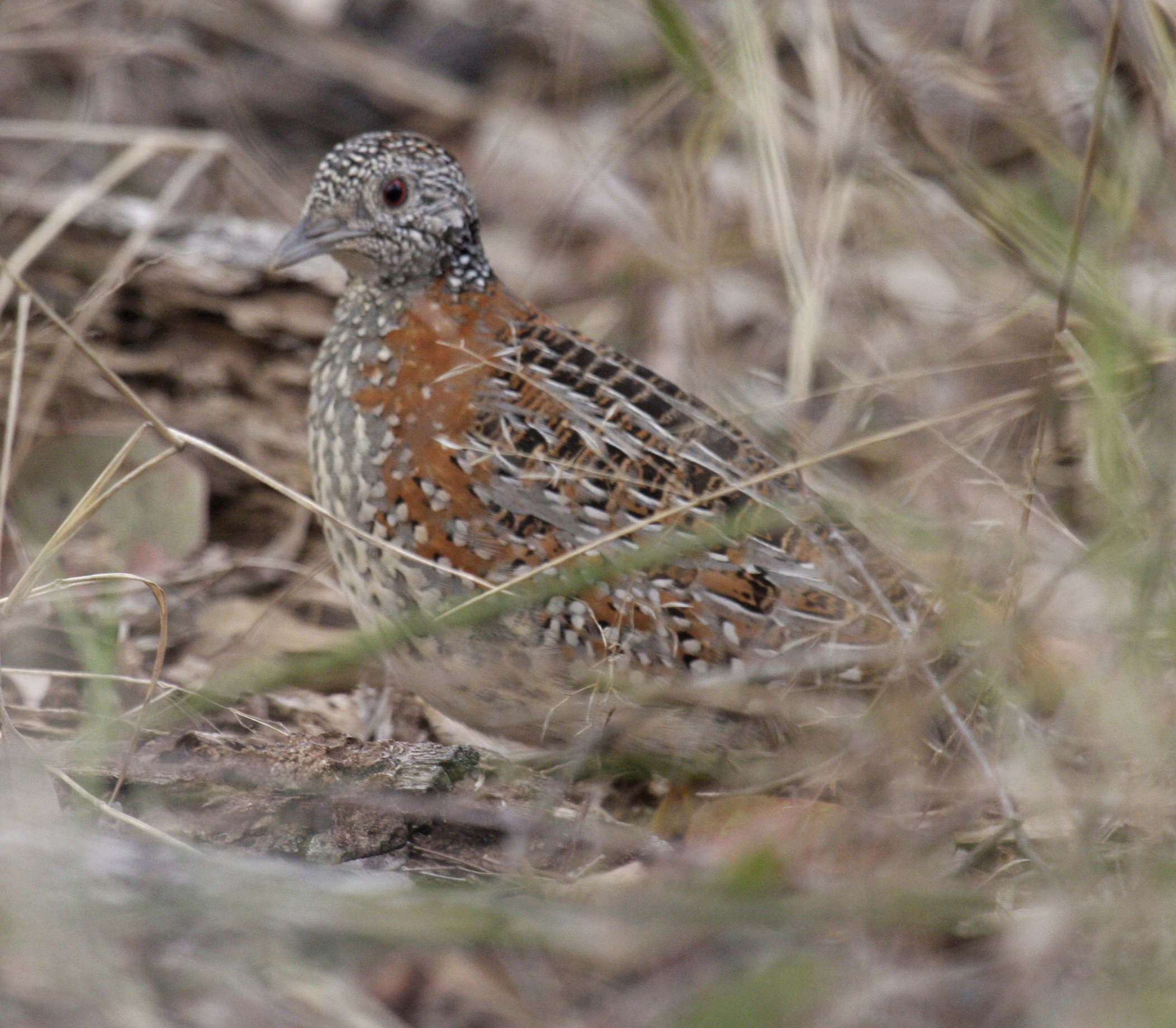
Local wildlife carer Catherine recently mentioned there are some Painted Button-quail about in Coal Point and she had a quail in care that had been caught by a cat; luckily there were no major injuries and it was released a few days later. Catherine mentioned there always have been quail here, but they are declining in numbers.

Rob Palazzi commented “our bird surveys have no records of the Button-quail, but that is sort of to be expected given that we walk through for a very brief check each month, and it is unusual to flush them when we stick to the tracks mostly.

The Painted Button-quail are known to forage using a curious twirling behaviour that results in a saucer sized flattening of the grass - if you find these it's a good diagnostic for their presence - almost as good as hearing a whipbird and calling that a definite presence! Good that the cat did no serious damage (this time) to the bird you found.”

The other wildlife that flitted through our bushland forest recently was a small wallaby/pademelon/kangaroo. It was sighted bounding about Burnage, gambolling at Gurranba and caught on dashcam at Oakhampton Court. As with the July sighting of the quoll, it is so good to know that we still have the capacity to receive wildlife through the connectivity of our bushland.

A note of neighbourly distress. 
"Two large, seemingly healthy gum trees were
removed from the front yards of adjoining properties last week - by separate contractors. It was very distressing considering these trees were so majestic, providing homes for nesting magpies as well as a safety net for possums and other local wildlife.

In the 37 years we’ve lived here we’ve watched maggies nesting in these trees - so sad to see the huge gap that remains. And so sad to hear the chain saws and munchers so regularly in Coal Point now."

Friday, 28 May 2021

Birds in the bush

A couple of interesting observations from the March bird survey conducted by avian enthusiasts Rob Palazzi and Michael Paver.
“Excitement plus with a few of the little birds present again. They’ve been missing for a few months, but, whilst not in big numbers, a few have reappeared.

Interesting also with the Satin Bowerbirds - they seem to be fairly regular now in Noorumba Reserve and sometimes flying between that and the Puntei Creek Wetlands Reserve. The bowers in the Wetlands and the West Ridge South appear to be gone, but Michael and I wonder if they might start again in Noorumba. Any local knowledge for that reserve would be useful.

The Carey Bay Wetlands is showing trends in numbers for the two most populous species - Noisy Miner and Rainbow Lorikeet, with the Miners declining and the Rainbows increasing over the last several years. It could be interesting to continue this trend mapping for this and other spots.”

Images R. Palazzi.

Tuesday, 21 July 2020

Give a hoot

The comings and goings of our fine feathered friends are foremost in the thoughts of many locals.

Wildlife Carer Catherine highlighted the harmful effects of rodenticides on owls and other birds.

Research in WA has also shown that up to 70% of boobook owls had detectable levels of rodenticides and 18% had lethal levels... this is most likely occurring in most suburban/regional areas throughout Australia. People are using the rodenticides near where I live, and I've had a few rats dying from poison in my yard. In 2018-19 our local boobook had 3 chicks and I hate to think of them dying from these poisons. I didn't see any chicks from last year's breeding season, so this is concerning. I have also sighted a masked and barn owl here in the past.

An ABC Article from 2017 further explains the impacts of rat poisons. 

If rodenticides must be used – first generation anticoagulant rodenticides are preferred because they break down more quickly than second generation anticoagulant rodenticides

When purchasing look for active ingredients:
  • FGARs (less toxic) - Warfarin, Coumateralyl (Ratblitz)
  • SGARs (more toxic) - Brodifacoum, Bromadioline (Ratsak & Talon)
We are very fortunate to still have these birds of prey in our area and whilst we have rats they have a meal, hopefully it won’t be their last. 

Do you miss the Powerful Owls?

Local bird-O Rod Mackay shared some Powerful Owl (PO) info.

Did you know POs will tend to eat the flying foxes, which spooks them and they relocate.

It’s been happening the last few years. All the bats in Blackalls would amazingly disappear about late April when the POs came back to the area to breed (April- September).

They were also responsible for clearing the bat population out of the Botanical Gardens in Sydney a few years back.

This is the first year for about six that we have had no POs around-disappointing, but that happens. Hopefully they will be back again next year.

PO’s have bred in our community and they may be encouraged to return if we employ measures to protect these owls from disturbance or harm. There are only 6000 Powerful Owls and pairs in Australia and locally we have one of them. 

The Birdlife Australia Project has a great fact sheet for managing vegetation for powerful owls. The information below is sourced from this.

The Powerful Owl is a majestic threatened bird species that lives only along Australia’s east coast. They produce very small clutches of only one or two chicks.Protecting breeding by avoiding disturbing vegetation is vital.

The spaces owls use are made up of native and non-native plants. Broad-leaf Privet (Ligustrum lucidum), a non-native evergreen shrub and a serious environmental weed, is particularly important to owls in many of the areas they roost and nest. In fact, privet is the only tree species supporting owls in many of the urban areas where they nest in Sydney.

Privet provides shelter for the favoured prey of Powerful Owls, and it forms a vital element for owls by providing cover that lets owls roost during the day, and the cool environment owls need to persist in summer. In many cases, these owls would be unable to breed without privet. A thick shrub layer is important for new chicks, which must climb home if they have a fall when learning to fly.

Powerful Owls are creatures of habit. They like to nest in the same hollows and roost in the same trees each year, and an individual pair of owls may do this for up to 30 years. Powerful Owls are particularly sensitive to disturbance during the breeding season between April and October. Disturbance in the core part of the territory where owls are raising their chicks may cause adult owls to abandon both the chicks and the nest. Changes to the tree canopy, cutting vegetation near the nest tree, fire and tree/branch falls near the nest tree have all been documented to cause Powerful Owls to abandon nesting.

Whilst bush regeneration is sometimes the only way to restore good function in bushland, if ill-timed or too enthusiastic it can cause great harm to owls and other wildlife. When bush/land care activities are taking place in a known Powerful Owl territory the following actions are essential to protect owls:
  • Protect all hollow-bearing trees;
  • Remove woody weeds in a mosaic pattern to retain habitat for owls and small birds;
  • Avoid clearing of any vegetation that provides protected roosting sites for adults;
  • Avoid vegetation trimming that opens the canopy in riparian zones (up to 15m from creek/river); and
  • No works are to be undertaken within 100 m of an identified nesting tree or recorded observation site during the breeding season.

Tuesday, 16 June 2020

Birding About


Rob Palazzi conducts a monthly bird survey around Coal Point- Carey Bay, ably assisted by Michael Paver. They’ve been monitoring a Satin Bowerbird nest on the West Ridge over the past 10 months and have provided some background on the bower habits of the local bowerbirds.

"The Satins like all birds need a rest period to get a break from the non-stop worry about breeding! The effort needed and the motivation to keep at it (bower-building) probably doesn’t go 12 months of the year. What will be interesting is how that old bower shows over the next several months.
The other bower in the Carey Bay Wetlands has been non-functional for some time now. It is unlikely, given the distance separating the bowers, that this is the same bird, so we might see both become active again come spring. Michael and I often see a male in Noorumba and he will sometimes fly off in the direction of the Wetlands reserve. There appears to be at least one female around that area as well. We have also recorded the two sexes down the school end of the Ridge, so probably two pairs.
Of note otherwise - the numbers of lorikeet (particularly Musk) will be reducing as the Spotted Gum blossom fades. They also like the Swamp Mahogany, which is flowering now, although there are only a few of these trees in the reserves.

We found a few of the smaller birds this month particularly on the Ridge reserves. A lone Lewin’s Honeyeater (a first for our surveys) plus a pair of Black-faced Cuckoo-shrike were nice visitors." 
Images courtesy Rod Palazzi.


Thursday, 23 April 2020

Birds about and abundant - Rob Palazzi

The recent rains and cooler weather looks like producing a good flowering on the Spotted Gum (Corymbia maculata) in our reserves. This species appears to be very appealing to the nectar/pollen eaters in the bird world. The several reserves with good stands of this tree - Stansfield in particular - had high numbers of Rainbow Lorikeet and Musk Lorikeet this morning. It should be interesting to watch how these numbers develop in the next month or so.

These same weather conditions have caused a rapid increase in insect populations. These food sources have brought out some of the smaller birds. On the West Ridge there were some very busy Grey Fantail, Brown Thornbill, Spotted Pardalote, Golden Whistler, Leaden Flycatcher and a family of Variegated Fairy-wren. Worth keeping an eye (and ear) open when out walking.

On 7/4/20 Rod Mackay also noted “I have never seen so many (Musk Lorikeets) along with their cousins the Scaly- Breasted, Little and, of course, Rainbow varieties.

Also, there are a pair of Brahminy Kites hanging out on the Lake at present- they don’t normally venture this far south, but good to see them circling around and trying to stay out of the way of Whistling Kites!

While you may not be seeing the Musk Lorikeet, you have probably been hearing them. The usual contact call is a shrill metallic screech, higher than the Rainbow Lorikeet, in flight and when perched. They constantly chatter when feeding.You can listen to them on the Birds in Backyard- site.


Owl Breeding season 2020 has begun

The big hoot has begun in NSW with owls a-callin’ and action all about. Many pairs are already sitting together and owls are in and out of hollows. This has all started about a month earlier than we have seen previously, and in line with breeding activity the 2019, young are beginning to disperse. This early breeding season is not unexpected given the change in climate we have been experiencing.

Whilst the presence of Powerful owls in our community is a wonderful thing, in order to keep them here they need to feel safe and undisturbed. DO NOT walk towards a breeding hollow under the tree! Ideally you don’t want the male to see you at all. A safe viewing distance is 30-50m at all times for your safety and the owl’s comfort.

Friday, 14 February 2020

A Bird in the Hand

Baza in care
The recent fires are causing changes in avian distribution and increasing the need for supplies for wildlife carers who are tending to injured animals. Our local wildlife carer Catherine “got a Sooty tern…from Grant Rd, and a red tailed tropic bird that some people brought down from up near Mudgee! The strong winds have blown these birds off course and they're exhausted. I also have 2 juvenile sooty terns and 3 pacific bazas - one of which is a young one that came from Lake View Rd near Jarret St.” If you are interested in donating funds to provide resources for local wildlife the CPPA has a Fur & Feathers fundraising page.
Red-tailed Tropic bird in care


The Pamper Care Project is asking for donations of fruit (especially Mangoes and Pears), veges and bird seed to help our local wildlife survive and relieve some the pressure off the carers.Donations can be dropped off at Woodrising Neighbourhood Centre Wednesdays and Fridays.

Female Golden Whistler
Every month local bird enthusiasts Rob Pallazzi and Michael Paver monitor our bird population. This month they were “very pleased to record the presence of a couple of 'smaller' species in the Cary Bay Wetlands such as the Golden Whistler, the female is almost the classic Little Brown Bird that birdwatchers all over seem to like to complain about on their excursions into the bush, the male is pictured.The Eastern Yellow Robin is a very welcome sighting always - they appear to almost follow a walker maybe hoping we might disturb some insects/food. Sometimes they will sit on the side of a branch near the path just quietly watching then pounce to the ground to grab some snack, then back up to their vantage point.”

Dr Grainne Cleary is compiling stories of changes in bird behaviour as a result of the recent bushfire season. Many birds and animals have been displaced by fires as they’ve 
lost their habitat, but where will they go? It is possible they may move into urban areas such as backyards and our local parks/ovals as they seek refuge. If you see any new and/or increase in birds/ animals that you see in your gardens, parks and neighbourhoods please email Dr Cleary clearygr@tcd.ie
Male Golden Whistler

Thursday, 9 May 2019

Bird Surveys April ‘19 -Rob Palazzi

Female Satin Bower Bird in nest
Carey Bay Wetland reserve is showing a stable variety of bird species, with slowly increasing numbers overall. Noisy Miner numbers are on the increase as are Rainbow Lorikeet numbers. The Satin Bowerbird has built a new bower and we look forward to a nest - fingers crossed.

Norumba is showing a similar pattern to other reserves with a stable variety of species and rising numbers overall. Noisy Miner numbers are on the increase, and others are holding their own. The male Satin Bowerbird from the Carey Bay Wetland reserve appears to use Norumba part time and was recorded again this month. The Pied and Grey Butcherbirds normally seen here were missing this month, but appear to be regular residents. A variety of Lorikeets and Parrots are present and are regular visitors here as well.

Burnage reserve is showing it’s usual low numbers but variety is fairly stable and numbers a bit up (although not this month).

West Ridge Central is showing a stable variety of species with steadily increasing numbers
Spotted Pardalote
recorded. Increasing numbers of both Rainbow Lorikeets and Noisy Miners over the last year or so have contributed to this increase. A sighting of one Spotted Pardalote and one Golden Whistler this month is very welcome. Some Yellow-faced Honeyeaters were using the reserve as part of their northerly migration. Michael has reported sighting another Satin Bowerbird bower in the reserve - we had one for some time a few years ago - good to welcome him back. Eastern Rosellas are apparently on the increase in this reserve as well.

West Ridge South is showing overall slow decline in numbers (note Noisy Miners and
Golden Whistler
Rainbow Lorikeet numbers steadily increasing so others in decline) although variety appears stable. This last survey (April) saw a couple of nice returns - the Golden Whistler and Grey Fantail to note two.

Stansfield: Numbers slightly up (mostly Noisy Miners) but variety fairly constant.

Trends for Threlkeld: overall numbers steadily down and number of species reducing steadily. Specifically : Lorikeets and Rosellas stable, Magpies down Noisy Miners up. Can only speculate as to why these changes.

All images: Rod Palazzi

Sunday, 27 January 2019

Birds in Our Backyard


Avian experts Rob Palazzi and Michael Paver have continued to survey the local bird community on a monthly basis since April 2018 following on from Threatened Species Last Stand project. Here are Rob’s highlights from the January survey.

The most recent survey noted the presence of the Dollarbirds - they turn up in the Spring/Summer and then disappear as it cools. There were lots this year, particularly down the Threlkeld end. They tend to establish a spot/perch and chase food on the wing from there, so I'm pretty confident the records show all different individuals. They migrate down here from PNG/Indonesia to breed, using tree hollows. They are related to the Rollers of elsewhere in the world.

There are some 'trends' in numbers: Carey Bay wetlands are showing a slow increase in both species present and numbers of individuals. The Noisy Miners peaked in number about September and have dropped right off in the last months (maybe the heat). Also we have very low numbers of Common Myna in the reserves - this may contrast with observations among the houses.

Monday, 10 December 2018

Neighbours noticing nature


Have you seen the White Headed Pigeons? 

Rod Mackay: “Positive sighting of a pair of White-headed Pigeons this afternoon (3/12/18) on an electrical wire at the Carey Bay Wetlands. They are probably breeding down here somewhere. I saw some a few years ago down near the pool at Toronto west , and have seen some further up the coast; but these two are a first for me this side of Ambrose St.

I also saw four Long-Billed Corellas last Friday on the Toronto Golf Course- now they are a long way from home judging by my bird book at least!: R


Bee in the moment

Coal Point Public School has been successfully awarded an Environmental Sustainability grant from Lake Macquarie City Council. The funds will be

The school appreciates the guidance and support of Coal Point Progress Association and Coal Point Landcare during the grant application process. 

used towards a native bee sanctuary. A native bee hive has recently been installed by bee expert Tobias Smith who also conducted a workshop with year 5 students at the school. This was followed up with a 'Bee Happy’ day with students encouraged to dress to the theme and workshop information shared via peer support groups. The grant funds will also be put towards rehabilitation and establishment of gardens throughout the school, installation of a water tank and garden consumables and equipment.


Sunday, 3 June 2018

More dead magpies discovered

In late April at least four more dead magpies were discovered around Rofe St. and reported to the EPA (ph 131 555).

If you discover any dead birds they can be taken to the Toronto vet who will store them until the EPA can pick them up for an autopsy.

If you have pets in the Rofe St. area, especially ones that like to interact with dead animals, please be aware that they could be at risk of poisoning if the dead birds are ingested.