So much wonderful wildlife still exists within our bushland suburb. These neighbours have shared their ‘faunal finds’ from a festive summer and made some forthright comments about walking on the foreshore with your four-legged friend.
Birds by the lake
There are several very old Casuarina trees on the water’s edge in front of my place.
An Australian Darter spends much of its time roosting on one of the Casuarina branches that overhangs the water on the Lake’s edge.
It “goes fishing” from this spot.
When it returns it rises out of the water to stand on a rock shelf immediately in front of the Casuarinas.
Here it spends quite some time, maybe up to an hour or more, preening itself and drying its feathers (it has a wingspan of approximately 95cm), before attempting to get to its roosting spot high up in the tree.
It then waddles over to the trunk of its tree and begins to climb/clamber up the tree using both its feet claws and its wings. Quite a feat for such a big bird and quite a sight to see!
Unfortunately when the darter is drying its feathers whilst sitting on the rock shelf it is susceptible to attack by dogs not on a leash, as recently was the case.
Another bird that has been in my yard numerous times during the last few weeks is a Buff-banded rail. A neighbour saw it and thought it was a quail, along with a couple of chicks. But it is too big to be a quail, this Bird is buff!
We greatly appreciate receiving the regular yellow newsletter and understand thework involved in its compilation. As owners of a waterfront property in Toronto, we enjoy meeting the people who walk along the foreshore past our house and we acknowledge the long-standing tradition. We only ask that people keep their dogs on leashes and clean up after them.- KR
Your paragraph re Waterfront Walking is welcome information but as one of those absolute waterfront property owners I would appreciate walkers of dogs picking up their dog poo they continually choose to ignore. Perhaps if their dogs were on leads they might notice when they are pooing. It is difficult to have my small grandchildren playing on our waterfront when so many dogs are roaming free.
Locally we are very fortunate to have two leash free areas in our community, Gurranba Reserve (308a Skye Point Rd) and Puntei Park (bounded by Hampton Street and Excelsior Parade), and there’s the substantial leash free area at Speers Pt Roundabout.Looking in the Lake
Some stunning sightings- The Gloomy Octopus aka Common Sydney octopus hasbeen spotted in an octopus’s garden off Rofe Street by a keen snorkeler.
Image (Sylke Rohrlach from Sydney, CC BY-SA 2.0 <https://creativecommons.org/licenses/by-sa/2.0>, via Wikimedia Commons)
A Spotted Eagle Ray was sighted splashing in the shallows around Carey Bay by some regular swimmers; it circled around a couple of times to investigate the non-ray shaped object, an exhilarating experience.
Return of the Squirrel Gliders! Ye ha.

I watch for squirrel gliders every sunset, and it has been a long wait, but over Christmas I have spotted glimpses of what I was sure were gliders, and yes, I have just witnessed a glider land on an iron bark, scamper up a few metres and then glide down to a macadamia tree. Our block is now quite forested, and I have let the grasses take over. I am honestly so excited by this sighting, and it confirms my concerns for the continued loss of our old mature trees throughout the peninsula.
Not sure if you know but I believe Lyn and I were responsible for the gazetting of Coal Point as a recognised squirrel glider location on the National register.
Hope you all get a similar thrill from this sighting. I'm very thrilled.
PS I have now seen two gliders gliding together towards the same trees. I haven’t quite worked out where they’re coming from, but we have a number of boxes they could be using. I also have a couple of boxes I need to replace, which must now be prioritised.
PPS I’ve been watching the gliders again this evening and think I have a handle on what they are feeding on. We have two groves of lady fingers bananas (big block plenty of room). The King parrots like the ripe bananas and it now appears that the gliders like the flowers.
The gliders also like Cocos palm flowers which we had previously recorded and which we also have growing. I’m concerned that these little possums are relying on introduced plants, or maybe it’s simply a case of them taking advantage of a good food source. Kind regards Darrell, Lyn & Jye.
The Squirrel Glider is listed as Vulnerable NSW due to habitat loss, degradation & fragmentation, along with loss of hollow bearing trees, food sources and predation by exotic predators. There is a lot we can do locally to assist our local population survive. Installing nestboxes, providing food sources and responsible pet ownership are key to their continued survival in our fragmented landscape.
The Neighbour
"I’ve been creating a backyard habitat for the local wildlife for 30 years, I have quite a jungle now so possums frequent, Brush-tailed and ring-tailed, birds have regular stop overs, the King Parrots were feasting on my Lilly-pilly, the Kookaburra’s that wake me in the morning and announce night-time perch in my trees to cack their chorus. The wild animals are ‘my pets’ frequent visitors that I welcome.
One animal that is not welcome is a neighbour’s cat that now stalks in my yard, climbs on my veranda, and lays in wait. Whilst I have tried to discourage it with hissing and chasing, it erupts from my garden and skitters home…and now it has killed a kookaburra. The sanctuary that I have created has become a killing field for someone else’s ‘pet’."
The Research
Many cat owners don’t believe their cat kills, but research has shown “pet cats kill 30-50 times more animals per km2 around towns than feral cats do in the bush”.
A 2020 article from ‘The Conversation’ - ‘One cat, one year, 110 native animals: lock up your pet, it’s a killing machine’ elaborates on these findings, and what can be done to reduce the cat attack impact and concludes “Keeping your cat securely contained 24 hours a day is the only way to prevent it from killing wildlife.”
The Poem
Killer Kitties by Suzanne Pritchard
I have a killer kitty and it looks so very cute
It likes to kill most anything that moves or tweets or hoots
I saw it with a blue tongue just the other day
It patted and it petted it to try and make it play.
But the Bluey’s lungs were punctured, and its head was kind of mauled,
So off into the compost bin the lifeless lump was hauled.
Then kitty found a lorikeet, a tawny frogmouth too
But the birds no longer twittered, only feathers left, half chewed.
We haven’t lived here very long my killer cat and I,
And I wonder why the birds no longer chirp when I go by?
There used to be such wildlife, it’s why we got this place
But now the eerie silence is my killer cat’s disgrace.
Perhaps I’ll get a bell and keep kitty in at night,
We’ll cuddle up together and stop the murderous blight
It’s such a shame the birds have gone, not just for us, but all
I guess the time has come at last to be cat responsible.
Almost a decade of Bird Surveys comes to an end
Since 2012 the CPPA has been fortunate to have had the support of enthusiastic bird surveyors recording the presence and noting the absence of our fine-feathered friends along the Coal Point peninsula. Between 2012-2018 Tom Clarke (left) undertook quarterly surveys. He handed the baton to Rob Palazzi (right) and Michael Paver (centre) who upped the ante with monthly surveys until the recent COVID lockdown. The sightings and pictures have been a regular part of the Chronicle.
The dynamic duo is now moving on and we offer our sincere thanks to them for their enormous contribution to our understanding of the local birdlife. The CPPA has been provided with a fantastic record of our local birdlife. Knowing what we have in such detail means we can also try to protect it. To have bird surveys covering almost a decade is a rare gift. Sincere thanks to Rob and Michael for providing your expertise and insights.
If you like looking at birds October 18-24 is the Aussie Backyard Bird Count hosted by Birdlife Australia.
If you’d like to be involved in regular bird surveys please get in touch with Suzanne at coalpointprogress@gmail.com.Neighbours noticing nature
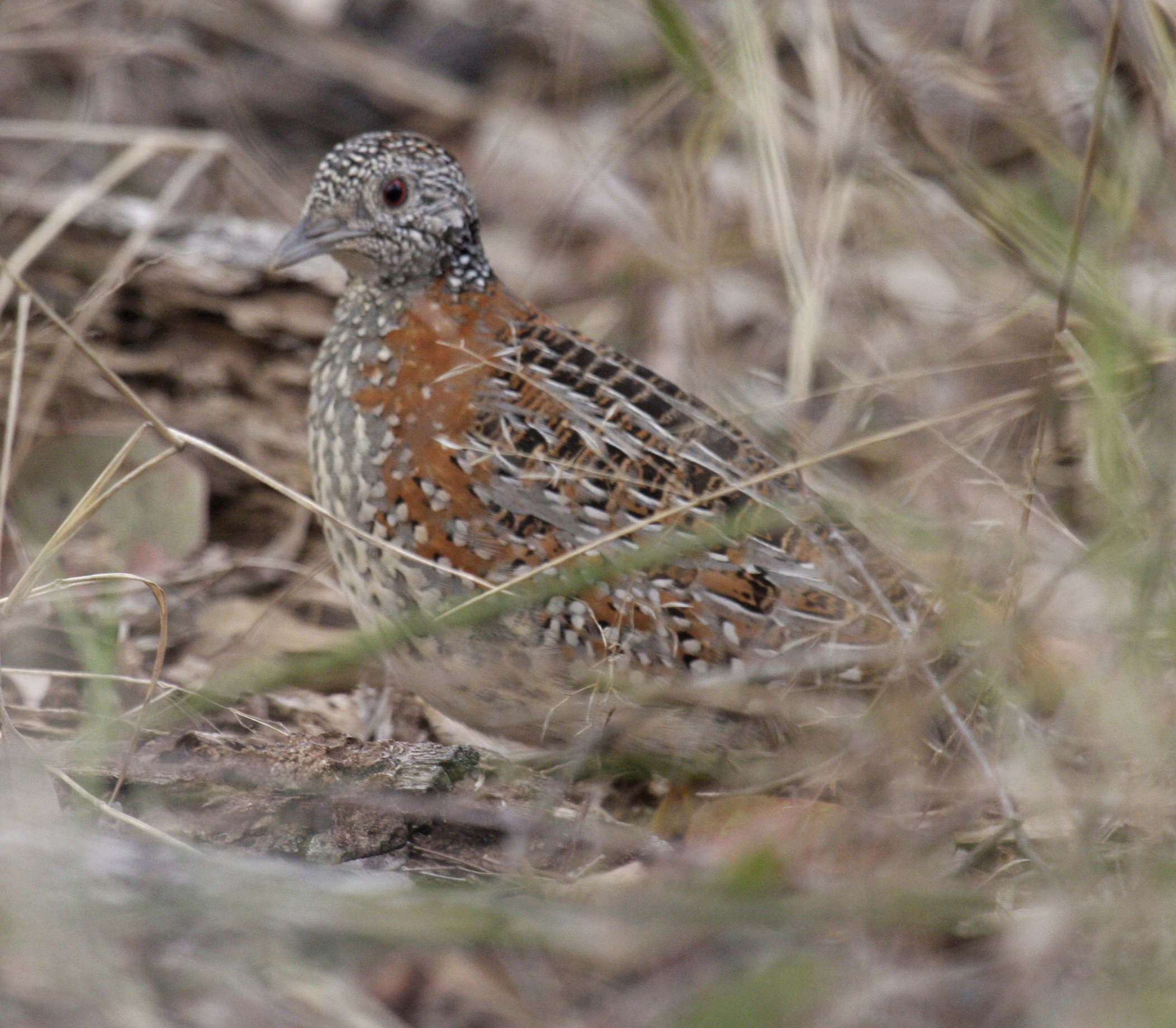
Local wildlife carer Catherine recently mentioned there are some Painted Button-quail about in Coal Point and she had a quail in care that had been caught by a cat; luckily there were no major injuries and it was released a few days later. Catherine mentioned there always have been quail here, but they are declining in numbers.
Rob Palazzi commented “our bird surveys have no records of the Button-quail, but that is sort of to be expected given that we walk through for a very brief check each month, and it is unusual to flush them when we stick to the tracks mostly.
The Painted Button-quail are known to forage using a curious twirling behaviour that results in a saucer sized flattening of the grass - if you find these it's a good diagnostic for their presence - almost as good as hearing a whipbird and calling that a definite presence! Good that the cat did no serious damage (this time) to the bird you found.”
The other wildlife that flitted through our bushland forest recently was a small wallaby/pademelon/kangaroo. It was sighted bounding about Burnage, gambolling at Gurranba and caught on dashcam at Oakhampton Court. As with the July sighting of the quoll, it is so good to know that we still have the capacity to receive wildlife through the connectivity of our bushland.
A note of neighbourly distress. "Two large, seemingly healthy gum trees wereremoved from the front yards of adjoining properties last week - by separate contractors. It was very distressing considering these trees were so majestic, providing homes for nesting magpies as well as a safety net for possums and other local wildlife.
In the 37 years we’ve lived here we’ve watched maggies nesting in these trees - so sad to see the huge gap that remains. And so sad to hear the chain saws and munchers so regularly in Coal Point now."